

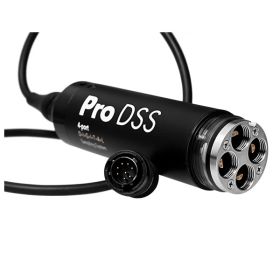
YSI ProDSS Total Algae Sensor
- Free ground shipping
- Expedited repair and warranty service
- Lifetime technical support
- More
 SCHEDULE DEMO
- Dual channel sensor
- Measures and outputs both chlorophyll & blue-green algae
- Options for ug/L and RFU outputs
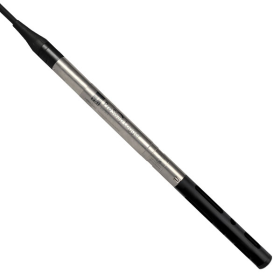
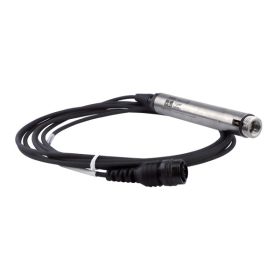
The Total Algae (TAL) sensors are dual-channel fluorescence sensors. The “channels” are for chlorophyll and phycocyanin (TAL-PC), or chlorophyll and phycoerythrin (TAL-PE), which are measured in the water. Each sensor thus yields two data sets: for TAL-PC, one results from a blue-emitting LED that excites the chlorophyll a (chl) molecule and the second results from an orange excitation beam that excites the phycocyanin (PC) accessory pigment. The TAL-PE sensor is similar, also having the chlorophyll channel, but rather than an orange-emitting LED there is a slightly blue-shifted beam that excites phycoerythrin (PE).
The TAL sensors generate data in RFU or μg/L of pigment (chl, PC or PE) units, with RFU as the default. When using either RFU or μg/L, the sensor’s response is highly linear: a reading of 50 of either unit represents twice as much fluorescence detected as a reading of 25, for example, if the temperature is constant.
ProDSS Smart Sensor Specifications:
| Parameter |
Range | Accuracy* | Resolution |
|---|---|---|---|
|
Conductivity |
0 to 200 mS/cm |
From 100 to 200 mS/cm: ± 1% |
**0.001, 0.01 or 0.1 µS/cm |
|
Temperature |
-5 to 70 °C |
± 0.2 °C |
0.1 °C or 0.1 °F |
| Dissolved Oxygen |
0 to 50 mg/L |
From 0 to 20 mg/L: ± 1% From 20 to 50 mg/L: ± 8% |
0.01 mg/L or 0.1 mg/L |
| pH |
0 to 14 |
± 0.2 |
0.01 |
|
ORP |
-1999 to 1999 mV |
± 20 mV |
0.1 mV |
| Turbidity |
0 to 4000 FNU |
From 0 to 999 FNU: ± 2% From 1000 to 4000 FNU: ± 5% |
0.1 FNU |
| Freshwater Total Algae |
0 to 100 µg/L PC |
r2 = 0.999 |
0.01 µg/L PC |
| Saltwater Total Algae |
0 to 280 µg/L PE |
r2 = 0.999 |
0.01 µg/L PE |
| Nitrate |
0 to 200 mg/L |
± 10% |
0.01 mg/L |
| Ammonium |
0 to 200 mg/L |
± 10% |
0.01 mg/L |
| Chloride |
0 to 1000 mg/L Cl |
± 15% |
0.01 mg/L |
*Reference specification for each sensor for more details on accuracy
** Range dependent
- Dual channel sensor
- Measures and outputs both chlorophyll & blue-green algae
- Options for ug/L and RFU outputs
The Total Algae (TAL) sensors are dual-channel fluorescence sensors. The “channels” are for chlorophyll and phycocyanin (TAL-PC), or chlorophyll and phycoerythrin (TAL-PE), which are measured in the water. Each sensor thus yields two data sets: for TAL-PC, one results from a blue-emitting LED that excites the chlorophyll a (chl) molecule and the second results from an orange excitation beam that excites the phycocyanin (PC) accessory pigment. The TAL-PE sensor is similar, also having the chlorophyll channel, but rather than an orange-emitting LED there is a slightly blue-shifted beam that excites phycoerythrin (PE).
The TAL sensors generate data in RFU or μg/L of pigment (chl, PC or PE) units, with RFU as the default. When using either RFU or μg/L, the sensor’s response is highly linear: a reading of 50 of either unit represents twice as much fluorescence detected as a reading of 25, for example, if the temperature is constant.
ProDSS Smart Sensor Specifications:
| Parameter |
Range | Accuracy* | Resolution |
|---|---|---|---|
|
Conductivity |
0 to 200 mS/cm |
From 100 to 200 mS/cm: ± 1% |
**0.001, 0.01 or 0.1 µS/cm |
|
Temperature |
-5 to 70 °C |
± 0.2 °C |
0.1 °C or 0.1 °F |
| Dissolved Oxygen |
0 to 50 mg/L |
From 0 to 20 mg/L: ± 1% From 20 to 50 mg/L: ± 8% |
0.01 mg/L or 0.1 mg/L |
| pH |
0 to 14 |
± 0.2 |
0.01 |
|
ORP |
-1999 to 1999 mV |
± 20 mV |
0.1 mV |
| Turbidity |
0 to 4000 FNU |
From 0 to 999 FNU: ± 2% From 1000 to 4000 FNU: ± 5% |
0.1 FNU |
| Freshwater Total Algae |
0 to 100 µg/L PC |
r2 = 0.999 |
0.01 µg/L PC |
| Saltwater Total Algae |
0 to 280 µg/L PE |
r2 = 0.999 |
0.01 µg/L PE |
| Nitrate |
0 to 200 mg/L |
± 10% |
0.01 mg/L |
| Ammonium |
0 to 200 mg/L |
± 10% |
0.01 mg/L |
| Chloride |
0 to 1000 mg/L Cl |
± 15% |
0.01 mg/L |
*Reference specification for each sensor for more details on accuracy
** Range dependent
Select Options


Customer Stories


